Saturday, August 7, 2010

Little Arrows

Ham radio never gets boring for me. I don't know if there is any other hobby that has so many different avenues for enjoyment. I would encourage everyone to try something new at least once a year. Fox hunting, contesting, moon bounce, digital modes, award chasing, microwaves, antenna building, whatever you think might be a fun change of pace.

My latest diversion is portable QRP satellite operations. John, K8YSE, noticed that I spend a fair amount of time travelling to 'exotic' locations around the Arctic so he sent me up an Arrow II dual-band satellite antenna . This little antenna is an amazing piece of craftsmanship. It consists of a two-piece aluminum boom about three feet long with a 7-element UHF yagi on one plane and a 3-element VHF yagi on the other. All the antenna elements are made from aluminum arrow shafts and they thread together at the boom. The whole antenna weighs less than two pounds and fits into a two-foot long 3" mailing tube for travelling. I already had a VHF handheld (which I hadn't ever used in the three years since I got it!) for the uplink and I was able to scrounge up a UHF handheld to receive the downlink. A $20 camera tripod from a discount store completed the package and I was ready to get on the air. After a bit of practice, I found I could assemble the entire station in about 5 minutes if I was in a hurry.


Operating from Fort McPherson, Northwest Territories in grid CP27

From studying a grid square map I determined that there are about a dozen different grids that I could operate from during my travels. Many satellite operators collect grid squares to qualify for the ARRL VUCC Award. Unfortunately, my far northern location limits the time for a mutual satellite window between here and the more populated areas of the world but on the plus side I can also reach over the pole to Europe and across the North Pacific to Asia. My first 'grid expedition' was to Fort McPherson, NT which lies in the CP27 grid. Less than two hours away by road, it is the southernmost location that I visit on a regular basis. On the first pass of the HO-68 satellite that day I made a whopping 16 QSO's, including two from Europe. Unfortunately, the rest of the passes that afternoon did not favor any populated areas so I only made a handful of contacts on the other birds. I had one good AO-51 pass scheduled for the end of the day and I decided to try to operate from Tsiigehtchic, NT in grid CP37 on the way home. That too didn't work out very well. I just barely made it there with 5 minutes before the start of the pass but for some reason I wasn't hearing the bird very well and I had a bad connection on the VHF radio antenna jack. By the time I had it all sorted out the bird was already over the North Pole and no one else was heard. Not to worry though. I travel to all these places at least once or twice a year so I will be back on from there sooner or later.
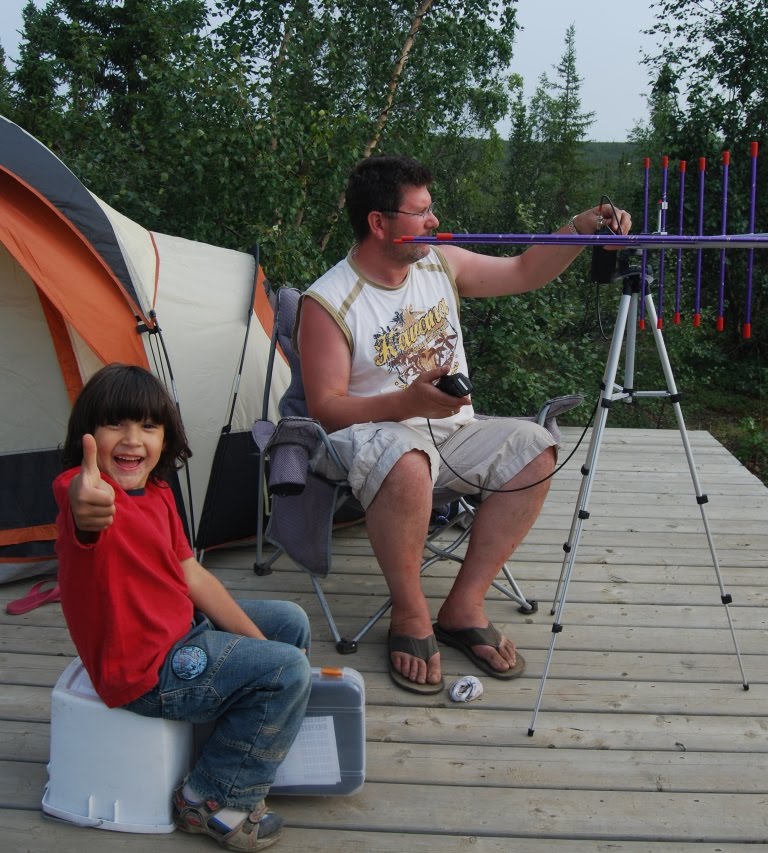

Camping on the August long weekend. My little nephew thinks satellite DX is pretty cool after we worked RN0QA in Yakutsk, Russia on AO-51.

I have special VE8EV/P QSL cards on the way from the printer for all my portable operations and will be happy to QSL via all the usual methods.

73 and look for you on the birds!

Sunday, May 16, 2010

The QSL Factory


The first wave of 700 CK8G QSL requests ready to be answered.


I really don't mind answering requests for QSL cards. I've had several people offer to be my QSL manager but I've got a great system for processing QSL requests that really makes it a breeze. The cards for my CK8G NA-182 expedition arrived this week so it was finally time to clear the backlog of requests that had built up since the operation ended. My post office box was already full when I returned from the island and in the intervening four weeks I've amassed a stack of envelopes about 500 strong! Add to that another 100 via the on-line QSL request system and 100 more for the GDXF bureau system and it could take weeks to get caught up. In fact, it took me all day Saturday from start to finish. Here are the secrets of running your own 'QSL Factory' for your next dxpedition or special event station:

  1. Start with a clean log. Every busted call in the log takes extra time to find and correct at QSL time. It's well worth taking an extra few seconds to confirm a call while you're on the air than to have to search for it in the log when its not correct. I try pretty hard to keep the average error rate below 1% (1 busted call in 100).

  2. Pre-print the QSL labels. Yes, ALL of them! I export the entire log (dupes and all) into Excel, sort it by callsign, and then run a mail-merge in Word to print the labels on Avery 5160 Easy-Peel laser printer label sheets, 30 to a page. Even up here in the Arctic a box of 3000 labels only costs $65. Once they're all printed I bind them (optional) with a plastic binding bar to become an easy to use book. When I get a QSL request it literally takes seconds to grab the book, flip to the right page and peel out the sticker and slap it on a QSL card.

  3. Don't try to do too many things at once as your workspace will get too crowded. I usually open all the mail as it arrives, check which operation it is for, unfold the reply envelopes, put the card inside the reply envelope with the IRC or return postage, and set it aside for further processing at a later date (usually when the cards arrive from the printer).

  4. Have self-inking stamps made for return address and verification (the little circle with your callsign that says 'QSO VERIFIED' or something like that). My arm would fall off if I had to hand write my return address on every envelope!

  5. Organize your workspace so everything you need is within reach. Blank cards, labels, stamps, tape, etc.

  6. Find a work flow that you're comfortable with and use 'key events' to regulate the flow so no steps are missed. I use the verification stamp as the key event to file the received card and switch from QSO lookup mode to envelope stuffing mode. The return address stamp is the trigger to set the now sealed envelope aside for adding postage and grabbing the next one.

  7. Don't waste time with distractions. Any request that needs something unusual (not-in-the-log, SWL request, requests for QSL's from multiple operations, etc.) just put it aside for later and keep going.

  8. Get self-adhesive postage stamps! I get mine in rolls of 50 stamps and I can stick them on a stack of envelopes faster than I could run the same amount of mail through a postage meter (although a postage meter is an option if you have access to one.)

  9. Know your postal system. You don't want any mail coming back to you or being delayed because of things you should have caught before it went out. Postal rates and requirements change often. Have a talk with the postmaster or a postal manager about what you're doing when you go to buy postage. Is there a discount for bringing it in bundled and sorted? Maybe a special deal for 'bulk' mailings that might be applicable? This would also be a good time to talk about IRC's and any specific requirements for trading them in for international postage.

Having all the QSL labels pre-printed really is the key, though. Forever more (and you will have people looking for QSL's forever) all you need to do is grab the book off the shelf and stick the label on a blank QSL card. No computers, no printers, no hand writing.

All the CK8G cards are now in a big shopping bag by the door ready to drop off to the post office in the morning. It almost didn't happen, though! I was not impressed with the quality of the QSL cards that I got from the printer. I know if I called to complain they would re-print them for me but that would mean waiting for another month and without much guarantee that they would be better the second time around. In the end I decided to send them out as-is. The color balance on the photo is a bit off but maybe I'm too much of a perfectionist...

Thursday, May 13, 2010

VE8EV/P - Instant Expedition

I've always put a great deal of effort and planning into my island trips. I've operated from up here for years so I know what the requirements are for success. Go when the propagation is good, take the biggest antenna you can, and run as much power as you can bring with you. Then, if you're lucky, you'll be able to fill the log with many contacts. How do I know all this? I've done it the other way before and it sucks! Low power to a dipole antenna from inside the auroral zone is next to useless except under optimal conditions.

When an emergency work trip to Sachs Harbour on Banks Island (NA-129) came up last week I grabbed my radio and the backup dipole antenna that was still packed from my Greens Island trip and set out to see what I could do with it in my spare time. The first night I was there I strung the antenna from my favorite flood light pole and spent a few hours on the radio. No huge pileups but with perseverance I was able to make a few dozen contacts on CW and SSB. It was all downhill after that.

For the rest of my four day stay I was only able to make a handful of additional contacts. The bands were crowded with no less than three contests running on the weekend (one each on CW, SSB and RTTY), the propagation got worse every day due to multiple solar flares and there was persistent local QRN that I couldn't locate. I called CQ endlessly, alternating between SSB and CW without any answers. At one point I even got up in the middle of the night and went up to the airport to try my luck during the peak midnight sun grey line hours. One contact. After a while I gave up and went back to bed.

I'm not giving up forever, though. I just need to be better prepared next time. Instead of a dipole, I'm going to build a lightweight, collapsible ZL-Special antenna for 20m. If I can find a way I'll get a little 300-400W solid-state expedition amplifier that'll lend an extra 6dB to my signal without the huge weight penalty of the FL-2100B. Then, a little Arrow dual-band yagi will get me onto the satellites to hand out the rare grid square to VHF operators. Hopefully I'll have everything together in time for my annual trip to Ulukhaktok on Victoria Island (NA-006) which I've conveniently scheduled to take place during the IOTA contest in July ;)

Wednesday, April 28, 2010

CK8G - The Perfect Storm

I remember when I first discovered Greens Island. I had just returned from a successful solo operation to Ellice Island (NA-192) as VX8X and my trip to Banks Island (NA-129) for VC8B was already scheduled for July. The next IOTA group on my list after that was NA-182 but I had no idea how I was going to do it. Nicholson Island (around here its still called Nicholson Point, it only became an island in the 1980's after a big storm washed away the isthmus) is tantalizingly close at only 150 miles from my home QTH. It has an unmanned radar station and a serviceable runway left over from the old DEW Line days but from my perspective it might as well have been in low earth orbit. I had talked to the techs that did the maintenance on the radar site and they told me that when they go in by helicopter they always carry a full load with no room to spare. Inquiries to the airlines revealed that chartering an aircraft big enough to bring in all the equipment and supplies and pick you up when you're done would cost over $10000! Tuktoyaktuk, NT is nearby and right on the coast but by boat from there it's still about 150 miles and you'd have to fly all your gear up to Tuk first. It just didn't seem possible and I was beginning to understand why it had only ever been activated once.

On the eastern side of NA-182 was the community of Paulatuk, NT. Much more expensive to fly into than Tuktoyaktuk but it was only 23 miles away from Clapperton Island. This looked like a much more plausible scenario and as I was measuring the distances on Google Earth I noticed there were several other small islands right by Paulatuk that one could almost walk to! I carefully examined each one but found that they either didn't really exist or did not qualify for IOTA for one reason or another. As I looked farther along the coast I came across a small island only 9 miles away that seemed to meet all the minimum criteria and it had an official name: Greens Island. I sent all the pertinent info to the manager of the IOTA program, G3KMA, and received a prompt reply that yes, it does qualify for NA-182 and would be added to the official list. Now I could start planning an expedition!


Greens Island from space on Google Earth. The white spots in the water are ice.

I travel to Paulatuk on business several times a year and I started talking to the airport maintainer there, Tim Ruben, about organizing a trip over to Greens Island. Tim is very much a 'can-do' kind of guy and told me that however we wanted to do it he would make it happen for me. By boat in the summer, snowmobile in the winter, supplies, equipment, whatever it took, he'd take care of that end of it. Over the next six months we stayed in touch as the plans developed. My first inclination was to try to organize a big operation. Three or four guys, two stations, round-the-clock operation, CW and SSB. Once I started crunching the numbers, however, I realized it just wouldn't be possible. Air travel in the Arctic is fantastically expensive. A return ticket just from Inuvik to Paulatuk is $1000 and air freight is $5 per kilogram. I knew I could count on the IOTA community and a few DX clubs to provide some support but as rare as NA-182 was in IOTA circles it still wasn't a rare DXCC entity. I finally concluded that with a concerted fundraising effort it might be possible to bring along one other operator to work CW. I asked a few guys to pass the word that I was looking for a second op to go with me to NA-182 and I waited.

Summer turned to fall and then back into winter again. I was very lucky for the second time and pulled off a respectable solo operation on Banks Island (NA-129) in July and after my holiday-style operation on St. Lucia (NA-108) at Christmas I turned my attention back to Greens Island. I hadn't had any bites yet for a second op so I posted a message on an IOTA forum that I was looking for another op to join a potential expedition in April. Much to my dismay, the request got picked up by the DX newsletters and was cross-posted around the world. Surprisingly though, even after going global, there was still very little interest. I did find one guy that was wanting to make the trip but after a few weeks of planning he dropped out of sight. With the proposed trip less than two months away I had to make some hard decisions. I had never been comfortable asking for donations so I had also been counting on the second op to manage a fundraising effort. Now there was no second op, no fundraising done and no publicity. I decided it was time to go solo. Two operators would have been nice but the window for that had closed. I set the target date as April 15-20 and made the announcements that it would be a single-op expedition. With the projected cost somewhat reduced, I set to work trying to raise support for the trip. I contacted a handful of prominent IOTA chasers, explained what I was trying to do, and asked for their help. Incredibly, not only were most of them willing to help but many were willing to send significant donations in advance of the trip! I was genuinely touched at their generosity and their confidence in my abilities. I also contacted several DX clubs that support IOTA activities and was pleased to receive commitments from the German DX Foundation and the Clipperton DX Club. Of course the one source of funding that I had counted on all along was the Island Radio Expedition Foundation. They had been strong supporters of my plans since the very beginning and I knew I could count on them again. Funding was in hand and all I had to do now was wait.

The exact timing of the operation would be critical. When I say I was lucky on my previous trips I meant just that. Operating in the Arctic auroral zone is tricky. If there was any significant geomagnetic activity then HF propagation from the island would be nil. I took the target dates for my operation and worked them backwards in 27 day increments, comparing them to the geomagnetic situation on those dates. While it is difficult to project that far ahead I didn't see anything that indicated there would be any recurrent instability. The official geomagnetic forecast for the period of my trip wasn’t issued until the second week of April but when it finally came out I was relieved to see that the days I had chosen were predicted to be the quietest of the entire month! Could I really be that lucky three times in a row?

As the departure date drew near I talked to Tim in Paulatuk every few days and we made the final arrangements. My original plan was to be fully independent. Rent a snowmobile, sled, tent and generator for the week and take care of myself with only a bit of help from Tim to put up the tower on the first day. A few days before I left I found out that wasn't going to be possible as no one in Paulatuk wanted to rent out their snowmobile for a whole week. After the adventures Cezar, VE3LYC, had on NA-231 at the end of March I was somewhat apprehensive about being left alone on the island with no transportation but decided I would have to make the best of it. In addition to my satellite phone, I also had a VHF radio to talk back to Paulatuk with and, of course, my HF rig so I was well connected to the outside world.

I was busy the week before I left making detailed lists and assembling all the equipment. I was being extra cautious as I didn't want to end up in the middle of nowhere missing one critical item needed to get on the air. All the important equipment had spares or a backup. Icom Canada kindly provided an IC-7200 that I brought along as a spare radio and I even brought an emergency dipole antenna and feedline just in case there was some sort of mishap with the tower and the yagi. Everything was carefully packed because it had to survive not only the airplane ride but a bumpy sled ride across the sea ice. I shipped most of the gear to Paulatuk the weekend before I left. I didn't want any of my freight to get 'bumped' on the day I travelled.


The weather forecast when I left was for high winds and unseasonably warm temperatures, right around freezing for the entire period. The hour and a half flight into Paulatuk was uneventful and Tim met me at the airport. Our first objective was to get fuel and water before the stores closed for the day. I was surprised to find out that there is no locally bottled water available in Paulatuk and I ended up buying a case of brand-name bottled water. Tim was insistent that he could get me an empty jug and fill it up with water at his house but if I was going to live in a tent for a week I wanted the good stuff! I also needed to get gasoline for the generator. Tim only had three jerry cans so we filled them up at the fuel station and he promised to bring out more as necessary. Then he took me to meet his brother in-law.

I hold Tim in pretty high regard. His excellent work maintaining the tiny airport was just a sideline to his real job as a heavy equipment operator keeping the streets clear, which is no small feat in a community like Paulatuk. Ferocious blizzards are commonplace and they had just finished digging out from one the day before I arrived. On my last visit I had told Tim what my budget for snowmobile rental and outfitting was and promised him the whole amount if he could get the job done. Instead of taking the money and trying to put all the pieces together himself, he passed the entire job (and the substantial fee) to his brother in-law, Pat Thrasher. Pat was a local professional guide and had everything we needed to make the trip a success. Snowmobiles and quads, sleds, the tent and a generator were all provided by Pat. Between the two of them I was well looked after and they even took turns bringing extra fuel out every couple of days.


Looking across the Paulatuk airport towards Greens Island. That's a six foot high fence disappearing into the snowdrift!

We waited until late evening for the winds to die down a bit before we headed out across the sea ice. I insisted on going slowly to minimize the trauma to the equipment in the sleds so it was almost 10pm by the time we reached the island. The sun was still shining when we arrived, only a few weeks away from being up for 24 hours, but by the time we had the tent set up, the yagi put together and the tower raised it was already past midnight. It was quite dark inside the tent and the small lamp that I brought was the only thing that did not survive the bumpy ride. After Pat, Tim and his wife headed back to town I got the tent squared away by flashlight and went to bed. The wind howled all night long but I was reasonably warm in my heavy sleeping bag and the generator and electric heater ran through the night.


Digging out the tent frame after arrival on Greens Island. The local people camp here in the spring watching for whales to arrive in the bay.

Waking up in the morning was a surreal experience. Here I was, finally, on Greens Island. The wind had died down and the sun was shining brightly. The generator was still humming outside and thanks to the electric heater it was quite comfortable inside the tent. I made myself breakfast and then set up the station. This wasn't my first trip to a rare location so I had a pretty good idea what to expect. I threw out the CK8G callsign a few times and quickly had an enormous pileup. Conditions really didn't seem that good the first day but I still managed to put 1000 in the log. Once the European sunset rush died out I worked more and more North American stations until the JA's and UA0's started calling in around midnight zulu. Then I'd turn the beam west and work Asia until the Europeans started calling again around their sunrise. That was more or less the same operating pattern for my entire time on the island. I got into the habit of taking a short nap every evening as that was the slowest time and then staying up until well after midnight. Conditions improved every day and it wasn't until after I got back home that I found out there had been no sunspots at all. Go figure! I also found out that the geomagnetic forecasts had been accurate and there was no significant auroral activity for most of my time on the island.


Looking north across the ocean towards Europe.

Most days were very much like the first. I kept to my stated intentions to give special attention to Europe and Japan. Europe was easy. Every day I would get up in the morning and start with the antenna pointed over the pole to Europe. The pileups were big and sometimes unruly but after three dxpeditions and lots of contesting I was fairly comfortable. The important thing was to keep the rate up. By-the-numbers, split operation, whatever it took, just keep growing the log. European cluster pileups can be worked through but you have to know what you're doing. After all these years it’s nice to finally have the mental tools required to pull off this kind of operation and it was especially gratifying after the operation to look at the comments on the dxcluster and see nothing negative. In fact, the only thing even close to a negative comment was early on when one op posted 'why no split?' The answer, of course, was that I had the attenuator on and the gain turned down and I was still working the loud guys at a decent rate. Running split takes up twice the bandwidth and I'll only do it if I can't maintain a decent rate running simplex. If you ever hear me spreading the pile out over 5kHz then you can bet there's a LOT of people calling me.

From a logistics point of view the operation was a smashing success. Other than a couple of mysterious glitches on the second day, Pat's 3500W generator ran flawlessly throughout the operation and it only burned about 30 litres of gasoline per day. Camping with a big generator is totally different than 'roughing it'. I had a 1500W electric heater that kept the tent cozy and warm. I brought along my drip coffee maker which, in addition to providing a nice cup of coffee on demand, also doubled to make hot water for instant soup. I had lots of cold cuts and bread and I even brought along 8 litres of fresh milk. The four cardboard cartons almost didn't survive the sled trip and were all leaking from broken bottoms but luckily I was able to decant them into empty water bottles. Every morning I had a nice bowl of cereal and milk in my coffee right up until the very last day!


This is how I spent most of my six days on the island. Sitting in the tent with my coffee cup at hand, keyboard in my lap, and big pileups on the radio!

After the first few days I started to notice a lack of North American and Asian stations in the log. I had very good propagation to the USA and Canada so I'm at a loss to explain why it seemed so hard to fill the log with W/VE stations. I received excellent signal reports, there just weren't a lot of callers. It was the same situation with Asia. I had received a considerable amount of support from Japan so I wanted to make a good showing there but they just didn't seem to be around in large numbers. On the other side of the Arctic Ocean, the band (I only worked 20m) was open to Europe almost around the clock. Half the stations in my log were European, almost 500 from Italy alone! For the last four days I spent each night calling CQ with the beam pointed west to Asia and worked more JA's and numerous VK/ZL stations. I even found a long-path opening to Africa in the wee hours that was previously unknown to me! In the final analysis, there was a fairly good mix of stations in the log and unlike my previous trips, this time I had lots of rare DX call in including a couple of dozen African stations and a smattering of rare Pacific islands. Final breakdown was 48% Europe, 37% North America and 14% Asia.

Like the propagation, the weather also steadily improved except for the third day. It had been windy since I arrived but on that day the winds were gusting to 80km/h. I turned the antenna edge on to the wind and left it there most of the day, afraid to turn it against the wind. The tent flapped violently and I thought for sure I was going to lose the tower. I went out a few times to check the guy ropes but since there was not much else I could do about it I just hunkered down inside the tent and kept making contacts. I kept one eye on the SWR meter all day watching for signs of impending doom. The next morning dawned calm, clear, and warm. When I crawled out of the tent I was surprised to find everything was just as I had left it. The tower was still standing, the antenna looked fine, and the generator was still purring away. The band was in excellent shape that day and after a great European sunset run I continued to work a mix of European and stateside stations well past midnight zulu.

Every expedition usually has a goal. Since this was strictly an IOTA expedition (ie; not also a rare DXCC entity) I didn’t have to worry about working multiple bands and modes. My only goal was to work as many unique stations as possible. In that respect as well, the operation was a huge success. Over 4500 different callsigns made it into the log. I can’t complain about the high number of duplicates (almost 400) as most of them came while I was calling CQ and guys just wanted to say hello and let me know I was getting out ok. In fact, I had a LOT of people mention how loud I was. It’s a little bit surprising since I was only running about 500 watts to the little TH3JRS yagi at 30 feet off the ground but I’m pleased all the same. I know there were many that had no idea who, what, or where I was and made the contact with me just because I had a big signal and an unusual callsign!


The sun shone every day while I was there.

By my last full day on the island I was starting to get the feeling that I was scraping the bottom of the barrel for contacts. Outside of Europe the pileups were mostly gone. I called CQ a lot and worked many QRP and mobile stations. What had really happened was that the aurora, absent for several days, had now returned and conditions were getting back to normal. I had received a few requests for some CW operation and in reality my CW skills are not all that bad but they’re not up to running a huge pileup. Now that things were quieter I did get on CW but I was short one USB port on the computer and could not use the mouse, keyboard, and CW keyer all at the same time. It was a bit awkward but I still managed to make a few dozen contacts in that mode.

I’d been living all alone in a tent in the middle of nowhere for a week and by the end I was ready to go home. The entire operation had gone very, very well and all I needed to do now was get myself and all my equipment off the island and safely back home. With the aurora out in force on the last night I made a few more contacts in CW and then pulled the plug. First thing next morning I started tearing down the station and by the time Pat arrived on the island at noon all that was left was to lower the tower and pack up the yagi. It was still unseasonably warm and there were several inches of water on top of the ice all the way back to Paulatuk. The huge snowdrifts that had greeted me on my arrival were all but gone and we had to use a truck to pull the sled into town and over to the airport. Once again luck was on my side and there was enough room on the plane for myself and all my equipment, even the tower sections! A few minutes after takeoff we flew past Greens Island and I couldn’t resist staring as it slowly passed and disappeared from view...

Thursday, April 22, 2010

CK8G Expedition News Archive

  • Back on the mainland safe and sound, waiting for the plane home. Final QSO tally almost 5000! (21 Apr 2010)
  • Last day, condx not so good. Might try CW this aft. (20 Apr 2010)
  • Ferocious winds today, afraid to turn antenna. 2500 Q's in the log, looking for JA tonight. (18 Apr 2010)
  • Propagation improving, over 1000 in the log. Having generator issues this am. (17 Apr 2010)
  • On the air. Propagation not great. (16 Apr 2010)
  • Coordinates of camp: 69.3744N 124.43015W (15 Apr 2010)
  • Arrived on Greens Island. Making camp. QRV in a few hours. (15 Apr 2010)
  • Landed in Paulatuk. Loading sleds for trip across the sea ice. (15 Apr 2010)
  • Packing the last of the gear. Weather forecast is for strong winds but should let up by the time I arrive on the island. (14 Apr 2010)

Thursday, April 8, 2010

CK8G - Countdown

Less than a week until departure and all is looking good for the operation from NA-182 Greens Island. Airline tickets are in hand and I’m now starting the final assembly, testing, and packing of equipment. I had hoped to be able to ship some of the gear into Paulatuk ahead of time on a charter flight but unfortunately things didn’t work out so now I’ll have to do it the expensive way. I’m going to send in most of the non-fragile stuff as cargo on the next few scheduled flights and then bring the rest with me when I go on Wednesday. My guy in Paulatuk informs me that the tent and generator have been arranged but finding a snowmobile to rent for a whole week is proving difficult. The weather is expected to be warm (single digits) and sunny so most people are planning to go out on the land and don’t want to be without their snowmobiles for that long. Not to worry though, if necessary I’ll get dropped off on the island and have supplies delivered or get picked up as needed. I’ll always be in VHF radio contact (or satellite phone if necessary) so no troubles. Frequent visitors are also likely as locals stop by to find out what the big tower and antenna on the island is all about.

Despite the big geomagnetic storm this past week, the forecast for the duration of the operation is for quiet conditions. The operating schedule will be Asia from 0000-0400z, Europe from 0400-0700z and 1400-1700z, North America from 1800-2300z. That’s generally where I’ll have the antenna pointed but will still happily take callers from anyone that is hearing me. I’ll be operating almost exclusively 20m SSB but I will bring a 40m dipole antenna as a backup.

My plane doesn’t land in Paulatuk until 4pm on Wednesday so I probably won’t be on the air until late that evening (early morning 15 April UTC). I'll be using my satellite phone to post status updates during the trip so watch this space for the latest information.

73
John - VE8EV