Call: VE8EV
Operator(s): VE8EV
Station: VE8EV
Class: Single Op HP
QTH: Inuvik, NT
Operating Time (hrs): 24
Summary:
Band QSOs
------------
160: 0
80: 1
40: 95
20: 431
15: 1009
10: 198
------------
Total: 1734 Sections = 80 Total Score = 277,440
Comments:
I had a whole assortment of issues all weekend but, oh boy, did the conditions ever make up for the things that went wrong!
I stayed in the chair for the whole 24 hours and for the first time ever I didn't run out of propagation. 15m was the money band all weekend. 40m was slow Saturday night but at least the rate meter never hit zero. When 15m got a bit too crowded for my liking on Sunday I went up to 10m and had a great run there for a couple of hours. I avoided 20m like the plague. It was wide open to everywhere at once and everyone was stacked two or three deep from one end of the band to the other although I did manage a nice run there during the last hour Sunday when it finally started to thin out a bit.
I went hunting for PR (last thing before bed Saturday night on 40m) and VI (first thing in the morning on 20m) and lucky I did as they were the only ones heard. All the rest came to me and the sweep was in the bag early Sunday. Also bested the old NT section record by almost 50K.
The computer crashed about a half a dozen times Sunday afternoon before I figured out the problem, apologies to those that I stranded in the middle of a contact. Despite the glitches, PowerSDR and the Flex worked like gangbusters dealing with the QRM and finding gaps to slide into.
Thanks to all for the Q's, especially all the '1 Alpha's that called in and muddled their way through the exchange for me to make the contact.
73 John VE8EV
Monday, November 21, 2011


Tuesday, October 18, 2011
As Good as it Gets
As regular readers might know, propagation at this latitude is always dominated by the aurora. Right overhead almost all the time, it seems that HF conditions here only seem to vary from "poor" to "nil". As this solar cycle started to ramp up (finally!) it seemed that things got even worse as the increased activity stirred up the aurora more than it improved propagation. Finally, though, I think we’ve reached the tipping point where the solar flux is high enough that signals are able to push through most of the auroral disturbance and thanks to a rare lull in the geomagnetic activity this past week the propagation has been absolutely astounding!
I’m in the process of moving so I haven't bothered to put the yagi back up after taking it down in July. With only a 23ft non-resonant vertical as a backup antenna I haven't been very active lately. Most of my contacts have been limited to the odd JT65 or CW QSO in the evenings. It was becoming rare to even hear stations on SSB (never mind trying to actually work them!) and I was beginning miss the days of zero sunspots and zero auroral activity when I could at least count on 20 meters to be open for a little while each day. Last weekend, though, with the sun spot numbers firmly in the triple digits and the solar flux index around 150, my perception totally changed. 10m and 12m were both open late into the evening here and 15m and 20m seemed to be going around the clock.
Friday evening I went out to the shack and was surprised to hear the T32C Kiribati expedition on 10m SSB. I easily worked them and then heard them again on 12m. And worked them. And then again on 15m. And worked them. In fact, just in the space of 90 minutes I had them in the log on 8 different band/mode combinations! With a just couple of hours again on Saturday evening and an early morning excursion Sunday for the low bands I had them on every band except 160m and a total of 18 band/mode slots all in one weekend. I’m usually happy just to make any contact with a big dxpedition. A couple of years ago I blogged about chasing the K5D Desecheo group and back in January I spent almost two weeks trying to work the VP8ORK expedition, only managing to eke out a single ESP-strength CW contact on 20m the one day that I could even hear them. And that was with the yagi and the amplifier!
According to the scientists predictions, this is it: the peak of cycle 24. Hopefully these conditions will last at least for the next several months. I sure hope so because the geomagnetic activity peak usually lags the sunspot peak by a few years. The forecast for this latitude a few years from now could be pretty gloomy...

The amazing conditions continued for the rest of the expedition!
Saturday, August 6, 2011
Shack of Ages
I was going through an old family photo album and found a picture I didn't recall seeing before. As a young 13-year old SWL this was my first "shack". The old Philips receiver was an early 60's solid-state unit and I remember that it was supposed to be powered by a dozen D-cell batteries but I had it wired up to an old car battery and a charger.

1977 - I used the little 3-channel CB to talk to my buddies with "walkie-talkies"
Many happy hours were spent tuning the world and collecting QSL cards from short wave broadcast stations and my walls were decorated with the schedules and posters the broadcasters used to send along with their verifications.
I pursued other interests as a teenager and it wasn't until my late twenties that I became interested in radio again. A new Yaesu FRG-8800 all-mode receiver quickly led to my amateur license and a second-hand Cubic Astro 151 rig.

1993 - The original ham shack. I spent a lot of time making digital contacts on AMTOR and the new (then) PACTOR mode.
A couple of years later I moved to a new QTH and upgraded to a Yaesu FT-767GX with the 6m/2m/70cm option modules. I also modified my FRG-8800 receiver with a 70cm downconverter and the factory 2m option module and worked the world via the AO-13 satellite. It was still a few years before cell phones, the internet, and text messaging and visitors to the shack were wowed by the amazing communications abilities via HF digital modes, intercontinental contacts through high-orbit satellites, and global messaging via LEO store-and-forward packet satellites.

1995 - World traveller Gwen VK3DYL calls home from the Arctic.
Life goes on and when I started a new family and a new career ham radio fell by the wayside. The equipment was disassembled, the shack converted to a children's room and there was very little free time left over for hobbies. It would be another ten years before I was finally able to get back on the air. This time I built the shack in a portable trailer so I could relocate it at will. A new Kenwood TS-2000 replaced the old radios and new soundcard modes in software replaced the TNC's and dedicated computers. Now, all the station functions were on a single PC and a single radio.


Having used the new console layout for over a year now, I find it to be completely satisfactory in all respects. I expect the layout will remain essentially the same for the foreseeable future and new efforts will all be focused on towers and antennas. That will be a good topic for a future posting :)

1977 - I used the little 3-channel CB to talk to my buddies with "walkie-talkies"
Many happy hours were spent tuning the world and collecting QSL cards from short wave broadcast stations and my walls were decorated with the schedules and posters the broadcasters used to send along with their verifications.
I pursued other interests as a teenager and it wasn't until my late twenties that I became interested in radio again. A new Yaesu FRG-8800 all-mode receiver quickly led to my amateur license and a second-hand Cubic Astro 151 rig.

1993 - The original ham shack. I spent a lot of time making digital contacts on AMTOR and the new (then) PACTOR mode.
A couple of years later I moved to a new QTH and upgraded to a Yaesu FT-767GX with the 6m/2m/70cm option modules. I also modified my FRG-8800 receiver with a 70cm downconverter and the factory 2m option module and worked the world via the AO-13 satellite. It was still a few years before cell phones, the internet, and text messaging and visitors to the shack were wowed by the amazing communications abilities via HF digital modes, intercontinental contacts through high-orbit satellites, and global messaging via LEO store-and-forward packet satellites.
1995 - World traveller Gwen VK3DYL calls home from the Arctic.
Life goes on and when I started a new family and a new career ham radio fell by the wayside. The equipment was disassembled, the shack converted to a children's room and there was very little free time left over for hobbies. It would be another ten years before I was finally able to get back on the air. This time I built the shack in a portable trailer so I could relocate it at will. A new Kenwood TS-2000 replaced the old radios and new soundcard modes in software replaced the TNC's and dedicated computers. Now, all the station functions were on a single PC and a single radio.
2008 - Back on the air after all those years.
The first time I ever saw an HP TouchSmart computer I knew I wanted one for the shack. I had been contemplating a rack mount console arrangement for a long time and the touchscreen was finally the motivation to build it. Both sides of console tilt forward for easy access to all the cabling in the back while all the controls are within easy reach. A wireless mouse and keyboard keep the number of exposed wires to a bare minumum.

2011 - A Flex 3000 software defined radio is the latest addition.
Friday, July 29, 2011
VE8EV/P - Instant Expedition
I'll be operating from Victoria Island NA-006 this weekend during the IOTA contest and as time permits. Hope to hear you!
Edit: operation was July 30 - August 1, 2011
Edit: operation was July 30 - August 1, 2011
Friday, July 1, 2011
RAC Day VE8RAC(VE8EV) SOSB/20 HP
Call: VE8RAC
Operator(s): VE8EV
Station: VE8EV
Class: SOSB/20 HP
QTH: Inuvik, NT
Operating Time (hrs): 20
Summary:
Band CW Qs Ph Qs CW Mults Ph Mults
----------------------------------------
160:
80:
40:
20: 260 566 12 12
15:
10:
6:
2:
----------------------------------------
Total: 260 566 12 12
Total Score = 97,200
Club:
Comments:
292 VE, 7 RAC
For me this turned into two completely different contests. The first one was Thursday. All night I had lots of callers and good rate on both modes. When things slowed down at 0630z I already had 500 QSO's in the log and had bagged all but a few multipliers. I grabbed three hours sleep and when I got back on things were still pretty slow and just went downhill from there. Lots of power line noise and very few signals to be heard. I struggled all day Friday to put 300 contacts in the log over 13 hours. I spent most of the day on CW as very little was coming through on phone. There were several zero rate hours around midday and I eventually threw in the towel an hour early, took my toys and went home. Apologies for all the mangled callsigns and CQing in the faces of callers I couldn't hear. Better luck next time!
Low points:
- What should have been an easy run of Europeans at midnight turned into a packet frenzy when someone spotted me as a rare IOTA island. I went split for a while but eventually gave up and retreated to the friendlier waters of the Pacific.
- I'm not a CW guy. I'm having lots of fun contesting in CW but my 20wpm repertoire pretty much ends after callsigns and 5NN+exchange. I felt like a deer in the headlights several times when guys felt the need to chit-chat. All FB, but I'm just not there yet. Maybe next year...
High points:
+ First contest with the new Flex, all integrated with the touchscreen and N3FJP for CAT, keying and voice. Sweet! Not a single hiccup through the whole event and when all the big signals were booming in Thursday night the sharp filter skirts almost brought a tear to my eye.
+ Almost making the dual-mode mult sweep. I had VY0HL call me on both modes Thursday night and at the end I only needed VY1 on CW and (doh!) NT on phone.
73 and Happy Canada Day!
de VE8EV
Operator(s): VE8EV
Station: VE8EV
Class: SOSB/20 HP
QTH: Inuvik, NT
Operating Time (hrs): 20
Summary:
Band CW Qs Ph Qs CW Mults Ph Mults
----------------------------------------
160:
80:
40:
20: 260 566 12 12
15:
10:
6:
2:
----------------------------------------
Total: 260 566 12 12
Total Score = 97,200
Club:
Comments:
292 VE, 7 RAC
For me this turned into two completely different contests. The first one was Thursday. All night I had lots of callers and good rate on both modes. When things slowed down at 0630z I already had 500 QSO's in the log and had bagged all but a few multipliers. I grabbed three hours sleep and when I got back on things were still pretty slow and just went downhill from there. Lots of power line noise and very few signals to be heard. I struggled all day Friday to put 300 contacts in the log over 13 hours. I spent most of the day on CW as very little was coming through on phone. There were several zero rate hours around midday and I eventually threw in the towel an hour early, took my toys and went home. Apologies for all the mangled callsigns and CQing in the faces of callers I couldn't hear. Better luck next time!
Low points:
- What should have been an easy run of Europeans at midnight turned into a packet frenzy when someone spotted me as a rare IOTA island. I went split for a while but eventually gave up and retreated to the friendlier waters of the Pacific.
- I'm not a CW guy. I'm having lots of fun contesting in CW but my 20wpm repertoire pretty much ends after callsigns and 5NN+exchange. I felt like a deer in the headlights several times when guys felt the need to chit-chat. All FB, but I'm just not there yet. Maybe next year...
High points:
+ First contest with the new Flex, all integrated with the touchscreen and N3FJP for CAT, keying and voice. Sweet! Not a single hiccup through the whole event and when all the big signals were booming in Thursday night the sharp filter skirts almost brought a tear to my eye.
+ Almost making the dual-mode mult sweep. I had VY0HL call me on both modes Thursday night and at the end I only needed VY1 on CW and (doh!) NT on phone.
73 and Happy Canada Day!
de VE8EV
Monday, June 20, 2011
XK1T - Snake Eyes
Every time I activate a rare island in the Arctic I always remember to give a large part of the credit to luck. Bad weather, either on the ground or especially in space, can scuttle the plans of even the most well organized expeditions. On our trip to Tent Island (IOTA NA-193) this time luck was definitely not on our side!
Planning for an activation of NA-193 began almost a year ago. Herschel was the only island in the Yukon Territory Group and it had been activated three times before. Despite the activity, demand for the group had increased over time and this year it landed back on the official IOTA "Most Wanted" list. Herschel Island is a bit far from here so I began studying the coastline with Google Earth and the official Canadian government mapping data. I quickly found Tent Island which was just a few kilometres inside the Yukon border and only 130 kilometres (by air) from home!
Gerry, VE8GER, has a 19' boat and our original plan was for a summer trip to the island during the IOTA contest in July. Gerry happened to make a trip up that way last summer and reported that in addition to very shallow water the area was inhabited by thick swarms of ferocious mosquitoes! We quickly decided that a snowmobile trip in the spring would be a far better idea and began to make plans accordingly. As spring drew nearer, however, we just couldn't fit a trip into our schedules and had to come up with a third option. We would go by boat in early June when the water levels would be highest and the mosquitoes would (hopefully) not be out yet.
It was a hot, sunny day when we set sail for Tent Island. We spent the afternoon packing the equipment and loading the boat and by 5pm we were underway for what was expected to be a four hour cruise. The route to Tent Island took us down the Mackenzie River through a 120km long maze of channels in the river delta followed by a 35km stretch across the aptly-named Shallow Bay on the Arctic Ocean.
Once again, though, lady luck spat in our eye. I got up around midnight and took over right about the time we ran out of propagation to Europe. I was expecting the band to stay open all night but now the only Europeans making it through were weak and watery and couldn't hear us at all. I stayed at it for several hours and put a few hundred JA's in the log but that was it. Around four in the morning the generator ran out of gas, the wind came up, and it started to rain. I went to bed happy that we were at least starting to make some progress and was sure that propagation would be even better tomorrow.
We kicked around the options and decided that there were only two. Either way we had to tear everything down and load up the boat and then we could either go home -or- we could wait out the storm in the boat, try to find a new campsite, and start all over. Given the conditions, finding a better spot seemed unlikely. Even if the rain quit right away it would still be days before everything (including ourselves!) dried out. The wind was pushing the water into the bay against the river current so the water levels were up. We decided to get while the gettin' was good. Gerry and I flopped around in the mud and rain for the next couple of hours tearing everything down and loading up the boat. We pushed off around 9PM and after an hour of pounding through the three and four foot swells on Shallow Bay we were safely back into the river channels and headed for home.
Final QSO total was only 830, fairly evenly split between North America, Europe, and Asia. Of those, 35 were on satellite and 5 on CW. Better luck next time, I hope!
Planning for an activation of NA-193 began almost a year ago. Herschel was the only island in the Yukon Territory Group and it had been activated three times before. Despite the activity, demand for the group had increased over time and this year it landed back on the official IOTA "Most Wanted" list. Herschel Island is a bit far from here so I began studying the coastline with Google Earth and the official Canadian government mapping data. I quickly found Tent Island which was just a few kilometres inside the Yukon border and only 130 kilometres (by air) from home!
Gerry, VE8GER, has a 19' boat and our original plan was for a summer trip to the island during the IOTA contest in July. Gerry happened to make a trip up that way last summer and reported that in addition to very shallow water the area was inhabited by thick swarms of ferocious mosquitoes! We quickly decided that a snowmobile trip in the spring would be a far better idea and began to make plans accordingly. As spring drew nearer, however, we just couldn't fit a trip into our schedules and had to come up with a third option. We would go by boat in early June when the water levels would be highest and the mosquitoes would (hopefully) not be out yet.
It was a hot, sunny day when we set sail for Tent Island. We spent the afternoon packing the equipment and loading the boat and by 5pm we were underway for what was expected to be a four hour cruise. The route to Tent Island took us down the Mackenzie River through a 120km long maze of channels in the river delta followed by a 35km stretch across the aptly-named Shallow Bay on the Arctic Ocean.
 |
| Tugboats and barges along the river as we head north towards the Arctic Ocean. |
We made good time through the river channels but once we arrived at Shallow Bay our luck started to change. We took this part of the trip very seriously as there have been many fatalities over the years with boaters running aground out in the bay miles from shore. Despite several attempts we could not find deep enough water to get out into the bay. After several close calls we decided to back-track and head an hour further north towards Langley Island and try to cross the bay from there. By this time the weather had turned cold and cloudy, a fog had rolled in, and there were two-foot swells rolling down the bay. By GPS and depth soundings we picked our way between the islands and finally made it out onto the bay. The heavy seas and fog made for slow going and there was rarely more than four feet of water under the keel all the way across. The swells were frequently breaking over the bow but we made steady progress. Shortly after midnight the fog lifted, the sun came out, and we caught our first view of Tent Island in the distance. Even that close to our goal we were still not sure we would be able to land. We tried several different approaches to the island that were all too shallow but eventually we found our way in and made landfall on the east side of the island. Two huge driftwood logs had blown up on shore and made for a perfect place to pitch the tent and provide anchors for the tower. We spent the next three hours unloading the boat and making camp. Our tent was a huge 12'x14' canvas wall tent and we took our time to make sure it was well secured. We were both well aware that the two big logs we were anchoring the tent to did not just fall out of the sky! When a storm blows in off the Arctic Ocean the surge can go several hundred metres inland and being only 2 metres above sea level it was obvious that anything on Tent Island could easily be washed away.
We made good time through the river channels but once we arrived at Shallow Bay our luck started to change. We took this part of the trip very seriously as there have been many fatalities over the years with boaters running aground out in the bay miles from shore. Despite several attempts we could not find deep enough water to get out into the bay. After several close calls we decided to back-track and head an hour further north towards Langley Island and try to cross the bay from there. By this time the weather had turned cold and cloudy, a fog had rolled in, and there were two-foot swells rolling down the bay. By GPS and depth soundings we picked our way between the islands and finally made it out onto the bay. The heavy seas and fog made for slow going and there was rarely more than four feet of water under the keel all the way across. The swells were frequently breaking over the bow but we made steady progress. Shortly after midnight the fog lifted, the sun came out, and we caught our first view of Tent Island in the distance. Even that close to our goal we were still not sure we would be able to land. We tried several different approaches to the island that were all too shallow but eventually we found our way in and made landfall on the east side of the island. Two huge driftwood logs had blown up on shore and made for a perfect place to pitch the tent and provide anchors for the tower. We spent the next three hours unloading the boat and making camp. Our tent was a huge 12'x14' canvas wall tent and we took our time to make sure it was well secured. We were both well aware that the two big logs we were anchoring the tent to did not just fall out of the sky! When a storm blows in off the Arctic Ocean the surge can go several hundred metres inland and being only 2 metres above sea level it was obvious that anything on Tent Island could easily be washed away.
 |
Setting up camp under the midnight sun at Tent Island, Yukon.
|
The following morning was a beautiful, calm, sunny day as we worked on assembling the tower, yagi, and HF station. Luck was still not on our side, though. The yagi had been strapped to the side of the boat and the heavy seas coming across the bay the night before had filled the traps with water. We spent the next two hours disassembling the antenna and taking apart the traps to dry the coils. Just after midnight zulu we finally had the antenna up and working and got on the air.
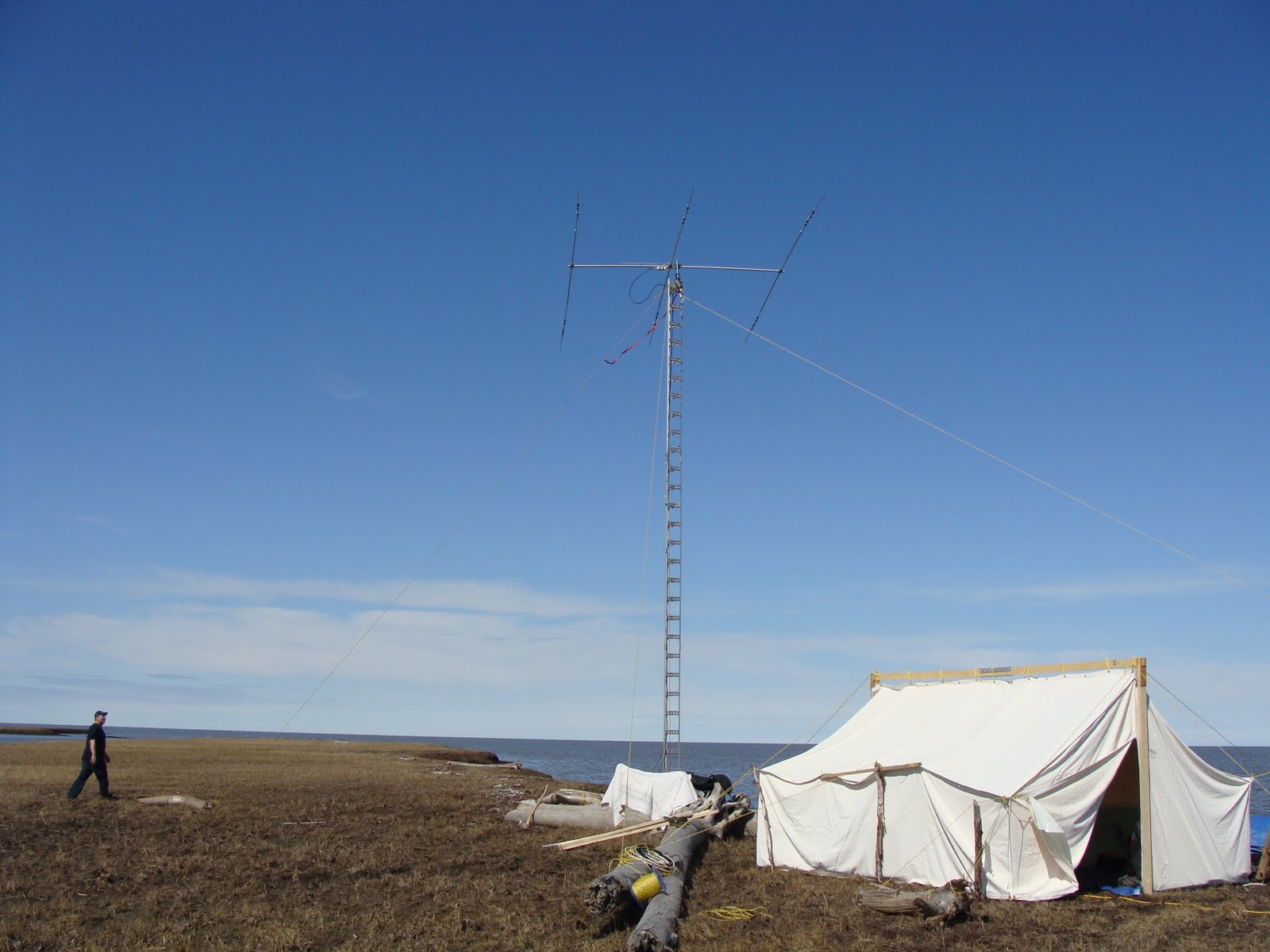 |
| Yagi all dried out, stood up, and ready to get on the air! |
Conditions were only fair the first night. After working North American sunset and some Pacific contacts we turned our attention over the pole to Europe. More bad luck. Only a handful of Scandinavian and Russian stations were making it through. We found out later that despite the promising auroral forecast, a solar coronal mass ejection and several small solar flares had conspired to keep the K-index at 2 or higher. We shut down at one in the morning that day with only 300 contacts in the log.
The next day was windy, cloudy and cool. The K-index was at 3 and we limped along until late afternoon when the propagation gave out entirely. I switched to CW and called CQ for over an hour with only 4 replies! Fortunately, I had also brought along my portable satellite gear and worked many stations via AO-51, SO-50, and AO-27 satellites.
 |
| Making our own propagation via amateur radio satellite. |
Things eventually picked up during NA sunset and then improved steadily all night. I had high hopes that we were finally going to get a big opening to Europe so while Gerry worked the early risers I took a nap and planned to come on at 0600z and run as long as I could. I dozed and listened to Gerry making slow, steady progress with what sounded like an unruly pileup. This was his first experience running with a big pileup and I thought about relieving him early but he was holding his own. I decided it would be better to rest up so I could focus on rate later on.
 |
VE8GER running his first pileup and doing a damn fine job!
|
Once again, though, lady luck spat in our eye. I got up around midnight and took over right about the time we ran out of propagation to Europe. I was expecting the band to stay open all night but now the only Europeans making it through were weak and watery and couldn't hear us at all. I stayed at it for several hours and put a few hundred JA's in the log but that was it. Around four in the morning the generator ran out of gas, the wind came up, and it started to rain. I went to bed happy that we were at least starting to make some progress and was sure that propagation would be even better tomorrow.
First thing the next morning Gerry was woken by a crash as the flapping tent had pushed the watt meter off top of the amplifier. I started to come around when he came back in from starting the generator, dripping wet from head to toe. The wind and rain had continued all night and water was running into the tent from numerous places. Upon trying the radio we found that the rain had soaked the traps again and the SWR was off-scale-high. We decided the best course of action would be to pack up the radio gear for safekeeping and wait for the winds and rain to die down so we could fix the antenna. I felt better after the gear was safely stowed but conditions continued to deteriorate. A support for the corner of the tent let loose and we struggled in the wind and rain to get it retied. Worse still was the ground. When we were setting up we found that the permafrost was only about six inches below the surface. With the heavy rainfall the ground was now becoming quickly saturated. Puddles started appearing in the tent as the ground under the tarpaulins kept getting squishier. Soon everywhere you stood a puddle would quickly form around your feet. Not yet willing to give up, I kept making satellite contacts from inside the tent, but things were not looking good. Around four in the afternoon I went outside and was horrified to discover the boat had come partially untied and was threatening to wash up on the beach. Having high seas push the boat up onto the beach and stranding us was my biggest fear! Worse still, it had dragged the rope across our fuel cache knocking over several gas cans which were now leaking our precious fuel! I hollered for Gerry and we spent the next hour repositioning the boat and getting it safely re-tied.
Once the boat was secured I surveyed our situation. The storm was not showing any signs of letting up. Our campsite had turned into a swamp and was well on its way to turning into a lake. Even if the rain stopped right away we would still have to abandon the camp site and (maybe) find a better place to pitch the tent. The yagi was still out of service until we could take it down and dry out the traps, and if we moved the tent we'd need to relocate the tower as well. We were both soaked to the skin and there were limited prospects of getting dry any time soon. I suggested to Gerry that maybe we should think about packing up and heading home.
 |
| Our perfect campsite transformed into a swamp and was now becoming a lake! |
We kicked around the options and decided that there were only two. Either way we had to tear everything down and load up the boat and then we could either go home -or- we could wait out the storm in the boat, try to find a new campsite, and start all over. Given the conditions, finding a better spot seemed unlikely. Even if the rain quit right away it would still be days before everything (including ourselves!) dried out. The wind was pushing the water into the bay against the river current so the water levels were up. We decided to get while the gettin' was good. Gerry and I flopped around in the mud and rain for the next couple of hours tearing everything down and loading up the boat. We pushed off around 9PM and after an hour of pounding through the three and four foot swells on Shallow Bay we were safely back into the river channels and headed for home.
Final QSO total was only 830, fairly evenly split between North America, Europe, and Asia. Of those, 35 were on satellite and 5 on CW. Better luck next time, I hope!
Subscribe to:
Posts (Atom)