Call: VE8EV
Operator(s): VE8EV
Station: VE8EV
Class: Single Op HP
QTH: Inuvik, NT
Operating Time (hrs): 22
Summary:
Band QSOs
------------
160:
80:
40: 23
20: 338
15: 387
10:
------------
Total: 748 Sections = 78 Total Score = 116,688
Club:
Comments:
This year's SS was a personal best for me and I'm finally starting to feel like I know what I'm doing. I was expecting the auroral activity on Saturday to keep me out of the game until Sunday but the high (not zero!) sunspot number compensated somewhat, at least on the higher bands. I managed to get over 200 into the log before before 15m and 20m closed up. I wasn't expecting much on the low bands Saturday night and I sure wasn't disappointed. Between 0200 and 0700 my score increased by only 24 points! Sunday morning the rate waxed and waned with the aurora as I alternated between running and hunting for mults. I knew the sweep was lost after spending a half-hour calling VO1HE without success. Things finally picked up mid-afternoon and I even managed back-to-back runs on 15m and then 20m until it closed up around 0100. 40m was slightly better than the night before but practically everyone I could hear was already in log so I pulled the plug and went home.
I'll post the usual in-depth write-up to http://ve8ev.blogspot.com later on today.
73
John - VE8EV
Monday, November 23, 2009


Monday, November 9, 2009
SS CW - Like Tornados and Trailer Parks...
I don't know what it is about ARRL Sweepstakes but for some reason it always seems to cause spectacular displays of aurora borealis. With everyone looking for that elusive 'Clean Sweep' of all 80 ARRL and RAC Sections this is the one contest where everyone wants to work a station in the far North but it always seems to be the one contest where we struggle the most with active geomagnetic conditions. This year's CW version of the event was no exception.
My rudimentary CW skills just aren't (yet) up to running with the lengthly SS exchange and after last year's somewhat meager results from my searching and pouncing, this year I invited CQ Contest Hall of Famer N6TR, Tree, to guest-op via a remote internet connection. Although we had planned to work the August NAQP contest as a test-run of the remote control set-up, various scheduling conflicts conspired to reducing us to a few quick connectivity tests in the weeks right before Sweepstakes. Of course there were a few minor glitches in the hour before the contest that raised our pulse rates a bit but in the end we had it all ready to go in time for the opening bell.
The remote control system was genius in it's simplicity. My Kenwood TS-2000 has a built-in software keyer. Send the radio plain text through the serial port and it will happily convert it to morse code and send it over the air. Various other commands sent through the serial port will do everything that can be done directly by pushing buttons or turning knobs on the front panel. By using the remote serial port software included with Ham Radio Deluxe, Tree's computer in Boring, Oregon had no idea that the serial port it was sending data to was on the back of my computer 1,600 miles away. SM5VXC's simple IPSound software routed the receiver audio and CW sidetone from my radio back to Tree's headphones. Other than the custom version of TRLog contest software that Tree whipped up to handle the logging and radio control, it really was almost as simple as it sounds. The rest of the station, however, was sorely lacking in electronic automation. It was my job to switch antennas, run the amp and the tuner, and (mostly for my own amusement) keep an eye on who we were working and what multipliers we needed.
The contest started with a bang Saturday afternoon. Conditions were great and Tree kept the rate at 80/hr for the first few hours. When darkness came, though, things started to slow down. Not so much because of band conditions, either. Tradition dictates that once it gets dark everyone QSY's to the low bands and spends the night working all their neighbors with low dipole antennas. Not so great for us guys on the edge of the world but we hung in there. My new, residential-area friendly (read: small) vertical antenna did a passable job on 40m given the distances involved. Our QSO total for both days on 40m was 45 contacts, which isn't bad considering that a) the antenna is only a 23ft whip, b) almost all of the contacts were 2000 miles+ and, c) conditions definitely were not the greatest. Our best DX on 40m was KP2M right around local midnight but it was also around then that the rate meter started sticking to the bottom peg so with almost 300 in the log we called it a night.
I knew 20m would be open for East coast sunrise so we were up 'n at 'em at 1130z the next morning. Sweepstakes Sunday is always a big deal from VE8 and I didn't see any reason why we shouldn't be able to put over 1000 in the log between now and the end of the contest. At least I didn't see any reason until I looked at the space weather. The K-index was at 4 and the NOAA auroral activity map showed a big, fat, red, angry-looking auroral oval on top of the world and it was right over our heads, stretching for hundreds of miles in every direction. The very few signals that could be heard were all weak and watery but in the true VE8 spirit Tree forged ahead and started scraping up whatever could be found. We could count all our contacts that morning on our fingers until 20m finally started to open a little bit around 14z and then the rate slowly crawled up into the double-digits.
Tree had done an excellent job collecting multipliers the previous night so despite the dismal conditions on Sunday we were only needing a handful of sections for the sweep. Slowly over the course of the morning the remaining mults trickled in with the last two (RI and UT) calling within a few minutes of each other late in the morning. With a sweep in hand I had even less to do except watch the meters bouncing and commiserate over the chat link with Tree about the painfully lousy conditions.
I had hoped the electric overcast would settle down later in the afternoon but it was unrelenting. The last few hours of Sweepstakes is always painful but by 0145z the rate was down to 2 or 3 per hour and we decided it was over. By sheer force of will Tree had managed to put 200 Q's in the log over the past 15 hours through an Arctic geomagnetic storm that would have had most hams looking for a new hobby (or at least watching TV all afternoon).

This 3-day geomagnetic activity chart for November 7-8-9 is pretty
self-explanatory. The first 27 hours on the chart was Sweepstakes CW.
We live on the northern boundary of the 'AURORAL' area.
Most of Canada and the USA is in the 'SUBAURORAL' area.
I dream of a someday having a Sweepstakes weekend with double-digit sunspots and K=0 but I've never seen one yet. Maybe one of these years it will happen. Oh, and in case you were wondering, here's the geomagnetic activity forecast for the rest of the month. Sweepstakes Phone is on November 21st...

My rudimentary CW skills just aren't (yet) up to running with the lengthly SS exchange and after last year's somewhat meager results from my searching and pouncing, this year I invited CQ Contest Hall of Famer N6TR, Tree, to guest-op via a remote internet connection. Although we had planned to work the August NAQP contest as a test-run of the remote control set-up, various scheduling conflicts conspired to reducing us to a few quick connectivity tests in the weeks right before Sweepstakes. Of course there were a few minor glitches in the hour before the contest that raised our pulse rates a bit but in the end we had it all ready to go in time for the opening bell.
The remote control system was genius in it's simplicity. My Kenwood TS-2000 has a built-in software keyer. Send the radio plain text through the serial port and it will happily convert it to morse code and send it over the air. Various other commands sent through the serial port will do everything that can be done directly by pushing buttons or turning knobs on the front panel. By using the remote serial port software included with Ham Radio Deluxe, Tree's computer in Boring, Oregon had no idea that the serial port it was sending data to was on the back of my computer 1,600 miles away. SM5VXC's simple IPSound software routed the receiver audio and CW sidetone from my radio back to Tree's headphones. Other than the custom version of TRLog contest software that Tree whipped up to handle the logging and radio control, it really was almost as simple as it sounds. The rest of the station, however, was sorely lacking in electronic automation. It was my job to switch antennas, run the amp and the tuner, and (mostly for my own amusement) keep an eye on who we were working and what multipliers we needed.
The contest started with a bang Saturday afternoon. Conditions were great and Tree kept the rate at 80/hr for the first few hours. When darkness came, though, things started to slow down. Not so much because of band conditions, either. Tradition dictates that once it gets dark everyone QSY's to the low bands and spends the night working all their neighbors with low dipole antennas. Not so great for us guys on the edge of the world but we hung in there. My new, residential-area friendly (read: small) vertical antenna did a passable job on 40m given the distances involved. Our QSO total for both days on 40m was 45 contacts, which isn't bad considering that a) the antenna is only a 23ft whip, b) almost all of the contacts were 2000 miles+ and, c) conditions definitely were not the greatest. Our best DX on 40m was KP2M right around local midnight but it was also around then that the rate meter started sticking to the bottom peg so with almost 300 in the log we called it a night.
I knew 20m would be open for East coast sunrise so we were up 'n at 'em at 1130z the next morning. Sweepstakes Sunday is always a big deal from VE8 and I didn't see any reason why we shouldn't be able to put over 1000 in the log between now and the end of the contest. At least I didn't see any reason until I looked at the space weather. The K-index was at 4 and the NOAA auroral activity map showed a big, fat, red, angry-looking auroral oval on top of the world and it was right over our heads, stretching for hundreds of miles in every direction. The very few signals that could be heard were all weak and watery but in the true VE8 spirit Tree forged ahead and started scraping up whatever could be found. We could count all our contacts that morning on our fingers until 20m finally started to open a little bit around 14z and then the rate slowly crawled up into the double-digits.
Tree had done an excellent job collecting multipliers the previous night so despite the dismal conditions on Sunday we were only needing a handful of sections for the sweep. Slowly over the course of the morning the remaining mults trickled in with the last two (RI and UT) calling within a few minutes of each other late in the morning. With a sweep in hand I had even less to do except watch the meters bouncing and commiserate over the chat link with Tree about the painfully lousy conditions.
I had hoped the electric overcast would settle down later in the afternoon but it was unrelenting. The last few hours of Sweepstakes is always painful but by 0145z the rate was down to 2 or 3 per hour and we decided it was over. By sheer force of will Tree had managed to put 200 Q's in the log over the past 15 hours through an Arctic geomagnetic storm that would have had most hams looking for a new hobby (or at least watching TV all afternoon).

This 3-day geomagnetic activity chart for November 7-8-9 is pretty
self-explanatory. The first 27 hours on the chart was Sweepstakes CW.
We live on the northern boundary of the 'AURORAL' area.
Most of Canada and the USA is in the 'SUBAURORAL' area.
I dream of a someday having a Sweepstakes weekend with double-digit sunspots and K=0 but I've never seen one yet. Maybe one of these years it will happen. Oh, and in case you were wondering, here's the geomagnetic activity forecast for the rest of the month. Sweepstakes Phone is on November 21st

SS CW VE8EV Multi-Op HP
Call: VE8EV
Operator(s): VE8EV N6TR
Station: VE8EV
Class: Multi-Op HP
QTH: Inuvik, NT
Operating Time (hrs): 24
Summary:
Band QSOs
------------
160: 0
80: 0
40: 45
20: 411
15: 21
10: 0
------------
Total: 477 Sections = 80
Total Score = 75,520
Club:
Comments:
Many thanks to John, VE8EV, for letting me operate the SS CW from VE8. It has always been a fantasy of mine to do this. Thanks to the internet and HRD software, and a little software of my own, I was able to operate the contest while sitting in Boring, Oregon. HRD provided a serial link to John's TS2000 and some enhancements to TR Log let me use the keyer in the TS2000 to send CW with. IPSound took care of getting the receiver audio back down to me. The delay from pressing F1 to hearing my CQ start in the sidetone was about 300 milliseconds - not bad at all. Sometimes the internet sound would hiccup which would do strange things to exchanges. I bet my error rate is a bit higher than normal as a result. Conditions at the start of the contest were FANTASTIC. First three hours were 85, 83 and 50. Around that time, things started happening with the aurora and the best hour I ever had afterward was 35. There were times the band had a funny "breathing sound" and most of the signals were all gone. Was very happy to get a clean sweep. Thanks to Eric, VY1EI for calling in for my only NT QSO. Was lots of fun giving some of the big guns their clean sweep!! Even more fun when they no idea who was behind the "key". 73 Tree N6TR
Monday, October 26, 2009
CQ World Wide - The Big One
We had so much fun in CQ WW last year that I've been eagerly anticipating this one for a whole year! With the new antennas permanently installed at the contest site there was no more field-day-style operations. Just tow the shack trailer up to the site, plug in the big TH6DXX yagi and the low band vertical, pop up the little TH3JRS on the trailer mast and away we go!
I was fully expecting this year's event to be a dismal failure. The geomagnetic field was predicted to be active all weekend. At this latitude, active geomagnetic conditions and low solar flux means no contacts on HF. Fortunately, Gabriel (the patron saint of ham radio) was still keeping an eye on us after our antenna raising last weekend and arranged for a flurry of sun spots to make up for the aurora.
Our only goals this year were to break the VE8 M/2 record we set last year and to make over a thousand contacts. Even with eight hours of auroral induced 'off-time' early Sunday morning conditions were otherwise very good and by Sunday afternoon both items were in the bag.
Lots of highlights over the weekend, here's the Top Ten List:
1. Starting the contest with a 100-hour on 20m. Now that's hitting the air running!
2. The excellent conditions on 40m Friday night. I worked all continents in the same hour just after midnight local time.
3. The surprise opening on 15m to Europe at 4am local time Saturday morning.
4. Working SU1KM in Zone 34 on Saturday morning for my LAST zone for the CQ WAZ award.
5. Working not one but TWO other VE8 stations (VE8DAV and VE8NSD) and VY0HL. Zero points for the contest but still cool and unusual!
6. Pushing the rate meter past 200 running stateside and JA stations late Saturday afternoon.
7. Having Wally ask me to work a Brazilian station on 15m that he'd been calling for 10 minutes with no success. He meant for me to use the big yagi and my amplifier but instead I just picked up his headset and made the contact with my first call. I told him the secret was "timing, tone and annunciation" ;)
8. Working several all-time new ones for DXCC. I've got to comb through the logs to find out which ones but I know for sure Tonga and Fiji and I'm pretty sure there's one or two more.
9. Working DP1POL in Antarctica on Sunday afternoon. I came across him CQing by himself and didn't even realize where he was until I put his call in the computer. We both said "Wow!"
10. Hunting multipliers off the cluster on Sunday afternoon I dialled up the QRG of some Caribbean station and the very first thing I heard was "who's the station with Victor?" I quickly threw out my callsign and into the log he went!

VE8DW shows off the broken record after finishing up on Sunday.
I was fully expecting this year's event to be a dismal failure. The geomagnetic field was predicted to be active all weekend. At this latitude, active geomagnetic conditions and low solar flux means no contacts on HF. Fortunately, Gabriel (the patron saint of ham radio) was still keeping an eye on us after our antenna raising last weekend and arranged for a flurry of sun spots to make up for the aurora.
Our only goals this year were to break the VE8 M/2 record we set last year and to make over a thousand contacts. Even with eight hours of auroral induced 'off-time' early Sunday morning conditions were otherwise very good and by Sunday afternoon both items were in the bag.
Lots of highlights over the weekend, here's the Top Ten List:
1. Starting the contest with a 100-hour on 20m. Now that's hitting the air running!
2. The excellent conditions on 40m Friday night. I worked all continents in the same hour just after midnight local time.
3. The surprise opening on 15m to Europe at 4am local time Saturday morning.
4. Working SU1KM in Zone 34 on Saturday morning for my LAST zone for the CQ WAZ award.
5. Working not one but TWO other VE8 stations (VE8DAV and VE8NSD) and VY0HL. Zero points for the contest but still cool and unusual!
6. Pushing the rate meter past 200 running stateside and JA stations late Saturday afternoon.
7. Having Wally ask me to work a Brazilian station on 15m that he'd been calling for 10 minutes with no success. He meant for me to use the big yagi and my amplifier but instead I just picked up his headset and made the contact with my first call. I told him the secret was "timing, tone and annunciation" ;)
8. Working several all-time new ones for DXCC. I've got to comb through the logs to find out which ones but I know for sure Tonga and Fiji and I'm pretty sure there's one or two more.
9. Working DP1POL in Antarctica on Sunday afternoon. I came across him CQing by himself and didn't even realize where he was until I put his call in the computer. We both said "Wow!"
10. Hunting multipliers off the cluster on Sunday afternoon I dialled up the QRG of some Caribbean station and the very first thing I heard was "who's the station with Victor?" I quickly threw out my callsign and into the log he went!
VE8DW shows off the broken record after finishing up on Sunday.
That's all until the next one. Thanks for all the Q's and we'll see you in Sweepstakes!
73 de VE8EVCQWW SSB VE8EV M/2 HP
CQ Worldwide DX Contest, SSB
Call: VE8EV
Operator(s): VE8EV VE8DW
Station: VE8EV
Class: M/2 HP
QTH: Inuvik, NT
Operating Time (hrs): 40
Summary:
Band QSOs Zones Countries
------------------------------
160: 1 1 1
80: 5 4 4
40: 73 17 34
20: 850 33 106
15: 130 16 22
10: 0 0 0
------------------------------
Total: 1059 71 167 Total Score = 624,036
Comments:
With active geomagnetic conditions predicted for the whole weekend I thought this was going to be a total washout but the unexpected sunspots compensated nicely for the electric overcast. The bands were great for the first 30 hours followed by 8 hours of zero-rate diode propagation when the K-index spiked overnight Saturday. More-or-less normal conditions after that for the rest of the contest.
Our goals were to get over 1000 Q's and break the VE8 record, both of which we accomplished. Full write-up http://ve8ev.blogspot.com/
73 and see you all in Sweepstakes!
John VE8EV Wally VE8DW
Friday, October 23, 2009
Thanks, Gabe!
We finally finished putting up the big yagi last Sunday. In typical fashion, the one weekend job ended up taking two full weekends to complete but we were taking our time and doing things right.


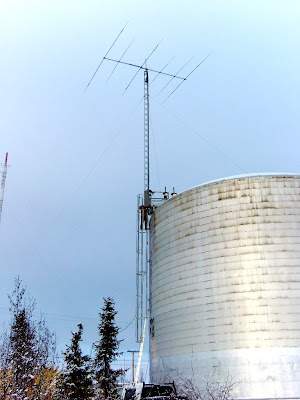
As I mentioned in my previous post, the tower is on the local water supply storage tank at the same location we do our contest operations from. The tank is 60 feet high and the tower is another 40 feet on top of that so a perfect perch for the big TH6DXX.
While I did most of the aerial gymnastics, VE8DW worked the ground end and snapped some great pictures.

Day 1. The old tower had not been used for many years.

Day 2. Tower is down and now mounting a gin pole to stabilize the old 18 foot long fiberglass VHF antenna as it comes off.

Day 3. Top section with rotator back on and assembling the yagi. I put the boom on first then rotated the mast to install the elements.

Day 4. Up she goes! The winds had been gusting all morning but right before we were ready to start the lift the wind stopped and the sun came out. Once we were done I Googled 'patron saint of ham radio' and found out it was Gabriel we needed to thank for the warm sunshine and the respite from the wind at the critical moment.
We'll find out how well it works this weekend during the CQ World Wide SSB Contest!
73 de VE8EV
Subscribe to:
Posts (Atom)